India’s USD 37 Billion Defence Market:
A Strategic Entry Guide for European Defence Companies (2026)
—————————————————————————————————————————–
Why should European defence companies enter India in 2026?
India offers European defence firms a $37B market, cost-efficient manufacturing, and a strategic supply chain solution amid Europe’s capacity constraints.
Europe’s defence landscape has shifted dramatically between 2022–2026. Rising geopolitical tensions, increased NATO commitments, and accelerated rearmament have created unprecedented demand—but also exposed structural production bottlenecks.
India is uniquely positioned to solve this.
The EU–India Security and Defence Partnership (2026) further strengthens this opportunity by institutionalising industrial collaboration.
Pawan Bhatnagar, Managing Director, Kasvu Consulting analyses the Indian Defence Market and provides a Strategic Entry Guide for European Defence Companies in India for 2026.
How large is India’s defence market in 2025–2026?
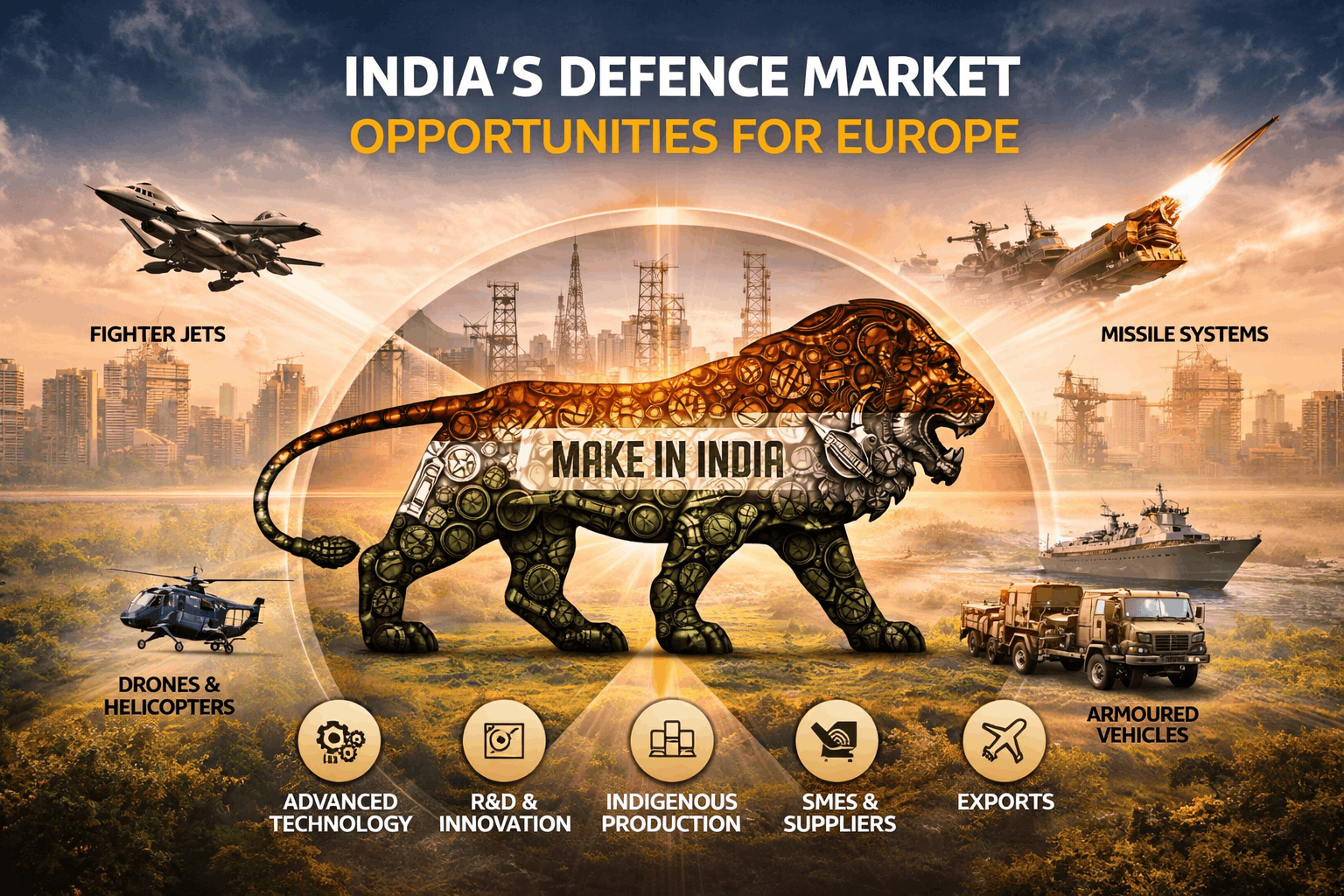
India’s defence market is ~$80B annually, with $20B+ in procurement and projected growth to $37B manufacturing output by 2030.
India is among the world’s top five military spenders, with consistent budget growth and a clear modernisation roadmap.
Key Market Indicators
| Metric | Value |
| Defence Budget (FY 2025–26) | ~$80 billion |
| Capital Procurement | $20+ billion |
| Defence Manufacturing Output(FY 24-25) | $18 billion (FY25)- doubled in 5 years |
| Market Size | $30+ billion, Projected $37 billion by 2030 |
| Defence Exports | $2.8 billion – to 80 countries |
| Private sector share of output | ~25% and rising |
| Global Rank(SIPRI 2024) | Top 5 globally |
India’s defence sector is no longer just procurement-driven—it is transitioning into a manufacturing and export-oriented ecosystem.
What changed after the EU-India defence partnership in 2026?
The 2026 EU-India defence pact creates formal industry collaboration channels, positioning India as a co-developer and supplier—not just a buyer.
The January 2026 agreement marks a structural shift in EU–India defence relations.
What this means for European companies:
- Formal industry-to-industry engagement channels
- Annual defence and security dialogues
- Joint maritime and security cooperation
- Recognition of India as a strategic manufacturing partner
This moves engagement from transactional procurement → long-term industrial collaboration.
Why is Europe’s defence capacity crisis an opportunity for India?
Europe’s defence demand exceeds production capacity, making India a critical partner for co-manufacturing, cost reduction, and supply chain expansion.
NATO’s June 2025 Hague Summit set a landmark 5% of GDP defence spending target by 2035 (3.5% core + 1.5% infrastructure). European defence industrial capacity is severely overstretched as demand is rising faster than industrial capacity can scale.
Structural constraints in Europe:
- Production backlogs across ammunition and platforms
- High manufacturing costs
- Fragmented supply chains
- Long lead times
India’s strategic role:
- Scalable manufacturing capacity
- Cost efficiency
- Expanding electronics and aerospace ecosystem
- Government-backed export push
For European defence companies, India is not a detouranymore from the European rearmament story — it is a supply chain solution for it. Co-manufacturing in India can address capacity constraints, reduce unit costs, and open export markets simultaneously..
What are the best entry models for defence companies in India?
European defence firms can enter India via JVs, co-development, iDEX, supplier integration, or MRO—each suited to different scale, risk, and timelines.
India’s Defence Acquisition Procedure (DAP 2020) requires localisation, making entry strategy critical.
Five Proven Entry Models
- Joint Ventures (JVs) – Best for large OEMs
- Partner with DPSUs or private primes
- Enables manufacturing and market access
- Co-development (Make I / II) – Best for technology leaders
- Government-backed programmes
- Shared development and procurement
- iDEX (Innovation Platform) – Best for startups and SMEs
- Low-cost entry
- Direct access to defence problem statements
- Supplier Integration (SRIJAN) – Best for component manufacturers
- Import substitution opportunities
- Faster revenue without full market entry
- MRO & Lifecycle Services – Best for recurring revenue
- Long-term service contracts
- Strong relationship-building pathway
What technology does India need from European defence companies?
India seeks European expertise in radar, EW systems, secure communications, AI, propulsion, and advanced materials to close critical capability gaps.
India’s defence modernisation is driven by clearly defined capability gaps.
High-Priority Technology Areas
- Advanced electronics & sensors
- Electronic Warfare Systems
- Secure Communications & Cybersecurity
- AI enabled & Autonomous Systems
- Aerospace Propulsion & components
- Advanced Materials & Composites
- Naval Systems & Shipbuilding Technologies
- Ammunition & Munitions Production
European firms—especially those offering ITAR-free/EAR free solutions—have a structural competitive advantage.
Why do foreign defence companies fail in India’s Defence Market?
Most defence firms fail in India due to poor partner selection, weak local strategy, underestimating timelines, and ignoring Indigenous Content requirements.
Failure in India is predictable—and avoidable.
Five Common Failure Patterns
- Over-reliance on DPSUs– Ignoring private sector and end-users.
- Late Indigenous Content (IC) planning– Failing to meet 40–60% localisation requirements.
- Underestimating timelines– Procurement cycles span 3–7 years.
- Wrong partner selection– Mismatch between capability and strategy.
- Confusing access with execution– MoUs without operational follow-through.
Success in India requires market navigation, not just market entry.
What should European defence companies do in India right now?
European firms should map capabilities to Indian demand, leverage ITAR-free advantages, choose the right entry model, and design local content strategy early.
Kasvu Consulting Assessment – March 2026
Kasvu Consulting recommends a structured, execution-first approach:
1. Start with capability mapping, not market access.
Align your portfolio with SRIJAN import substitution lists and DRDO co-development priorities.
2. Leverage ITAR-free advantage.
Position European solutions as they are easier to deploy and have less restrictions than US alternatives.
3. Use EU–India framework.
Engage through EU delegations and bilateral industry channels.
4. Choose the right entry model.
Match strategy to company size, technology maturity and investment horizon.
5. Design Indigenous Content Strategy.
Build localisation into manufacturing strategy and supply chain in accordance with DAP 2020.
6. Think beyond India.
Use India as export hub for Southeast Asia, Middle East, Africa.
FAQs
Is India a defence manufacturing hub or just a buyer?
India is rapidly evolving into a defence manufacturing and export hub, supported by policy reforms, private sector growth, and global partnerships.
India’s trajectory is clear: From import dependence → co-development → export capability
How long does it take to win a defence contract in India?
Winning a defence contract in India typically takes 3–7 years, requiring sustained engagement, local partnerships, and early compliance planning.
Patience and persistence are strategic advantages.
What is the fastest way for European SMEs to enter India defence?
The fastest entry route for European SMEs is through iDEX or supplier partnerships, enabling low-risk engagement and faster validation with Indian defence users.
Conclusion: India Is No Longer Optional
India’s defence market is no longer a future opportunity—it is a present strategic necessity for European defence companies.
- Demand is accelerating
- Policy framework is mature
- Industrial ecosystem is expanding
- EU alignment is strengthening
The window is open—but execution will determine success.
—————————————————————————————————————————–
About Kasvu Consulting
At Kasvu Consulting, our specific expertise is in Finland–India and Europe-India business synergies — working with European companies to navigate the procedural, cultural, and regulatory complexity of India’s defence market.
We do not offer introductions. We offer market navigation: capability mapping, stakeholder analysis, entry model structuring, IC compliance strategy, and sustained on-the-ground engagement support.
Ready to assess your India defence strategy?
Kasvu Consulting provides bespoke market entry analysis, stakeholder mapping, and partnership structuring for European companies entering India’s defence and dual-use technology sectors.
Contact: contact@kasvu.consulting
Website: www.kasvu.consulting