
What Does It Actually Take to Bring a German Delegation into India’s Defence Sector?
For German defence companies entering India’s defence market, success combines market research, partner qualification, regulatory guidance, trusted institutional relationships, and disciplined project management long before the first business meeting begins.
Business delegations are often judged by the number of meetings they generate. Those numbers certainly matter. But the real measure of success is whether those meetings create the foundation for long-term commercial partnerships.
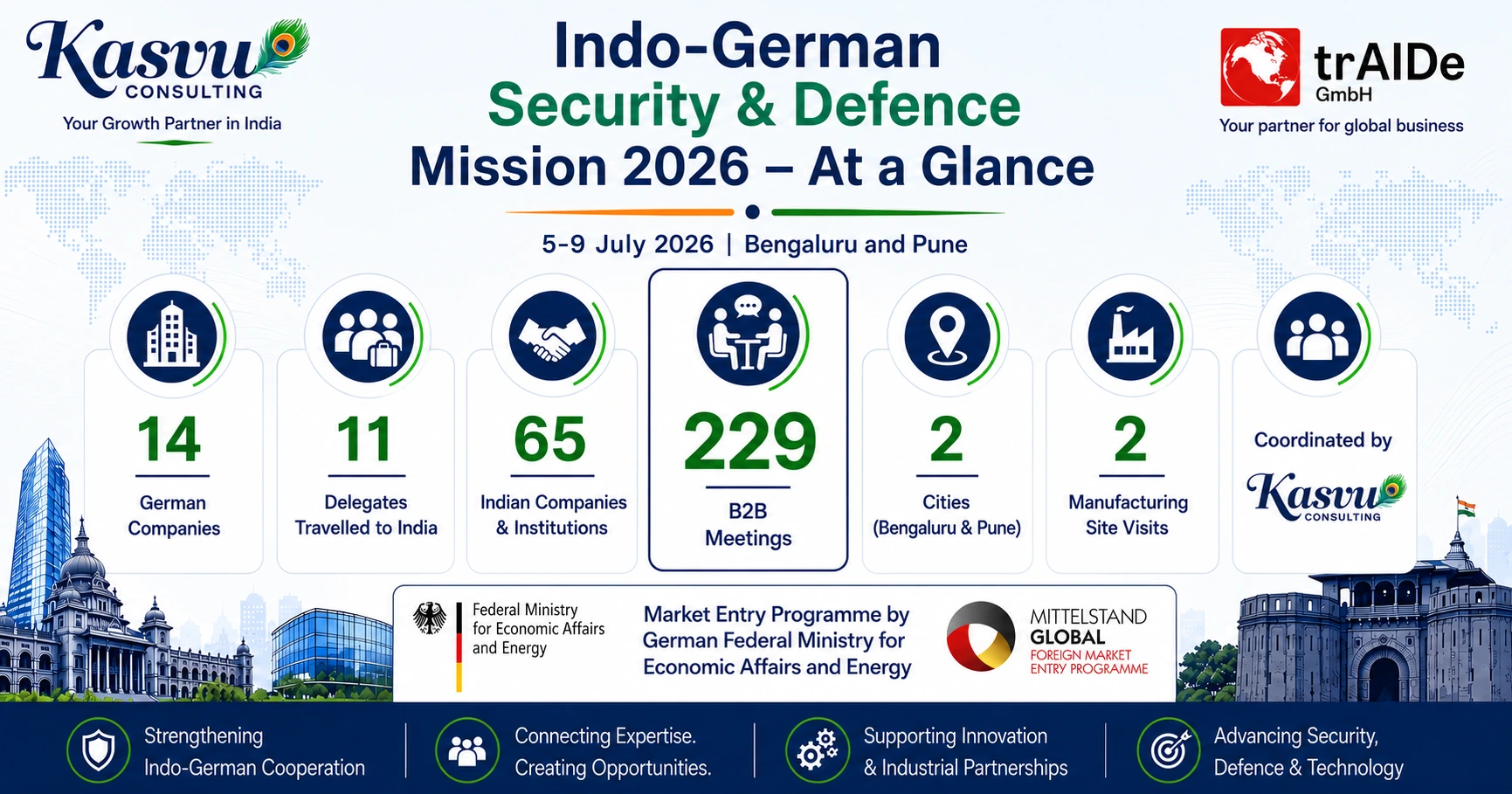
Between 5 and 9 July 2026, fourteen German defence companies entering India’s defence market —eleven of which travelled to India—participated in an Indo-German Security & Defence Matchmaking Mission to Bengaluru and Pune. The programme was organised by trAIDe GmbH under the German Federal Ministry for Economic Affairs and Energy’s (BMWE) Market Entry Programme for SMEs, implemented by Germany Trade & Invest (GTAI).
Kasvu Consulting served as the Indian implementation partner, responsible for the end-to-end planning and execution of the programme in India. Under the leadership of Col Pawan Bhatnagar (Retd), Co-Founder and Managing Director of Kasvu Consulting, the Indian programme was curated and managed from concept to completion, including market research, company profiling, partner identification, long-listing, speaker coordination, Industry Forums, B2B matchmaking, manufacturing site visits, delegation logistics and post-mission follow-up.
Having led multiple European market-entry programmes across sectors including defence, manufacturing, renewable energy and industrial technologies, one lesson continues to be reinforced: successful market entry into India is built on preparation, credibility, institutional relationships and continuity—not simply on arranging meetings.
Mission at a Glance
| Mission Metric | Result |
|---|---|
| Mission Dates | 5–9 July 2026 |
| German Companies | 14 |
| Delegates Travelling to India | 11 |
| Indian Companies & Institutions | 65 |
| Cities | Bengaluru & Pune |
| Confirmed B2B Meetings | 229 |
| Average Meetings per Company | Nearly 21 |
| Manufacturing Facility Visits | 2 |
The programme exceeded its contractual objective of five meetings per participating company, delivering an average of almost 21 qualified business meetings for each participating German company.
The delegation engaged with 65 carefully selected Indian companies and institutions, including major industry leaders such as Adani Defence, L&T Precision Engineering and Systems, Godrej Aerospace, Mahindra Defence Systems and Nibe Limited, together with numerous specialised SMEs supporting India’s rapidly expanding defence manufacturing ecosystem.
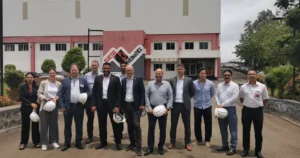
Delegates also visited Unimech Aerospace and Manufacturing Limited in Bengaluru and Electro Pneumatics and Hydraulics (India) Pvt Ltd in Pune, providing first-hand exposure to India’s manufacturing capability rather than simply hearing presentations about it.
The numbers were encouraging. More importantly, they reflected months of structured preparation rather than five days of activity.
Why Is a Defence B2B Matchmaking Mission More Than a Trade Show?
Successful defence matchmaking depends far more on preparation, partner qualification and institutional credibility than on the meetings themselves.
Many companies imagine a matchmaking mission as a series of scheduled meetings conducted in a hotel conference room.
In reality, the value of such programmes is created long before delegates board their flights.
Every participating company underwent an extensive preparation process involving:
* Individual market-entry consulting
* Company-specific partner profiling
* Market research
* Long-listing of prospective Indian partners
* Regulatory briefings
* Cross-cultural business guidance
* Validation of prospective partners against each company’s technology, products and commercial objectives
By the time the delegation arrived in Bengaluru, each meeting had already been carefully curated around strategic business objectives rather than simply filling a calendar.
The Industry Forums in Bengaluru and Pune served an equally important role by creating institutional confidence and providing delegates with practical insights into India’s evolving defence ecosystem.
In Bengaluru, Dr. C. G. Krishnadas Nair, Padma Shri, President Emeritus of the Society of Indian Aerospace Technologies and Industries (SIATI) and former Chairman of Hindustan Aeronautics Limited, spoke about India’s emergence as a global aerospace and increasingly space manufacturing hub, while sharing practical guidance on technology partnerships and long-term growth.
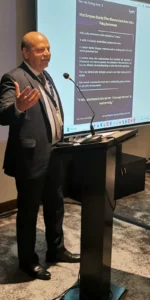
Drawing on more than a decade of advising European companies entering the Indian market, Col Pawan Bhatnagar (Retd) shared practical strategies for navigating India’s defence ecosystem. His sessions focused on market-entry strategy, cross-cultural negotiations, institutional engagement and localisation planning, emphasising that commercial success in India depends as much on trust, patience and relationship building as on technological capability.
Mr. Toni Verghese of JSA Advocates & Solicitors delivered an important keynote on India’s regulatory framework—often the first significant challenge faced by international companies entering the market.
In Pune, Mr. Harsh Gune of the Mahratta Chamber of Commerce, Industries and Agriculture (MCCIA) highlighted Maharashtra’s rapidly growing defence and aerospace ecosystem, while Lt Cdr Jasbir Singh Solanki (Retd) of Mahindra Defence Systems shared candid insights into the common mistakes foreign companies make when approaching India’s defence manufacturing sector.
Together, these sessions ensured that delegates left with a realistic understanding of India’s opportunities as well as its complexities.
Why Was Project Management the Difference Between Meetings and Outcomes?
Successful international delegations require a single point of leadership that integrates government stakeholders, industry partners and participating companies into one coordinated programme.
One aspect of international trade missions is often overlooked.
Behind every successful five-day programme lies several months of planning, coordination and execution.
As Project Manager for the mission in India, Col Pawan Bhatnagar (Retd) led the planning and delivery of the Indian programme on behalf of Kasvu Consulting, coordinating with trAIDe GmbH, participating German companies, Indian industry bodies, government stakeholders, speakers and manufacturing partners.
The responsibilities extended well beyond event management and included:
* Designing the India programme
* Market research and company profiling
* Partner identification and qualification
* Long-listing and B2B meeting curation
* Speaker identification and coordination
* Industry Forum planning
* Manufacturing site visits
* Delegation logistics
* Stakeholder management across Germany and India
* On-ground programme execution
* Post-mission follow-up
The result was a coordinated programme that connected carefully selected European companies with qualified Indian organisations through meaningful business engagements rather than transactional introductions.
What Makes a Defence Market-Entry Mission Successful in India?
Long-term commitment, localisation, trusted partnerships and continuous engagement are the foundations of successful defence market entry into India.
Every market-entry project is different.
The underlying success factors, however, remain remarkably consistent.
Across multiple European market-entry programmes organised over the past decade, five observations continue to emerge.
1. A Delegation Is the Beginning, Not the Strategy
Companies that view India as a long-term strategic market consistently outperform those seeking immediate commercial results.
2. Operating Models Must Be Defined Early
Questions relating to localisation, partnerships, technology transfer and customer support should be addressed before commercial negotiations begin.
3. Relationships Are Built Through Continuity
India rewards consistency.
One successful visit rarely creates a lasting partnership. Trust develops through regular engagement and a visible local presence.
4. Institutional Networks Matter
Strong relationships with industry bodies, government institutions and established manufacturers frequently open opportunities that conventional business development cannot.
5. Cross-Cultural Understanding Is a Competitive Advantage
The most successful European companies recognise that market entry into India is not simply a commercial exercise. It requires understanding how decisions are made, how relationships develop and how trust is established within the Indian business environment.
Why Is Local Market Support Critical for Entering India’s Defence Sector?
Local institutional relationships accelerate market access by helping foreign companies navigate regulations, partnerships and long-term business development.
Kasvu Consulting operates from New Delhi, Pune and Helsinki, creating a two-way platform connecting European companies with India.
Our work extends far beyond introducing companies to one another.
We support clients throughout the market-entry journey through:
* Market research
* Partner identification and qualification
* Strategic market-entry consulting
* Delegation planning and execution
* Regulatory guidance
* Cross-cultural advisory
* Business matchmaking
* Institutional engagement
* Post-mission relationship development
These activities are supported by long-standing relationships with organisations such as SIATI, MCCIA and the Indo-German Chamber of Commerce—relationships built over years of collaboration rather than individual projects.
Experience has repeatedly shown that local credibility, institutional access and sustained engagement frequently determine whether promising introductions evolve into long-term commercial partnerships.
Frequently Asked Questions
1. What should the German Defence Companies Entering India’s Defence Market know?
German defence companies typically enter India through structured market-entry programmes that combine market research, qualified partner identification, regulatory guidance, localisation planning and sustained local engagement.
Successful entry rarely begins with product presentations alone. Companies that invest time in understanding India’s procurement ecosystem, regulatory framework and industrial partnerships generally achieve stronger long-term outcomes than those relying solely on distributor searches or trade exhibitions.
2. What happens during an Indo-German defence delegation?
An Indo-German defence delegation combines business matchmaking, industry forums, factory visits and individual consulting to connect qualified German companies with carefully selected Indian partners.
Delegates participate in sector briefings, institutional meetings, curated B2B matchmaking sessions, manufacturing visits and networking activities designed around each company’s products, technologies and commercial objectives.
3. How many meetings should a successful defence delegation generate?
Meeting quality matters more than quantity, but well-prepared defence delegations should consistently exceed minimum contractual targets through carefully qualified business introductions.
During this mission, fourteen German companies completed 229 confirmed B2B meetings, averaging nearly 21 qualified meetings per company—more than four times the contracted minimum.
4. What mistakes do European defence companies make in India?
The most common mistakes are expecting quick results, underestimating localisation requirements, relying on transactional introductions and failing to maintain a continuous local presence.
India’s defence sector rewards long-term relationship building, institutional trust and strategic commitment rather than short-term sales activity.
5. Why is localisation important in India’s defence sector?
Localisation strengthens competitiveness by aligning foreign technologies with India’s industrial ecosystem, regulatory requirements and long-term procurement priorities.
Companies that develop realistic localisation strategies, identify suitable Indian partners and invest in sustained collaboration are generally better positioned for long-term growth within India’s expanding defence manufacturing ecosystem.
Author’s Perspective
Over the past decade, I have had the privilege of working with European companies entering India across defence, aerospace, manufacturing, renewable energy and industrial technology.
Each project has reinforced the same conclusion.
Market entry into India is rarely constrained by technology. More often, success depends on understanding institutions, building trusted relationships, navigating cultural differences and committing to a long-term presence.
This delegation reaffirmed that principle once again.
The 229 meetings achieved during five days in Bengaluru and Pune were not the success story. They were the outcome of months of preparation, collaboration and disciplined execution by stakeholders in Germany and India working towards a common objective.
Looking Ahead
India continues to strengthen its position as one of the world’s most significant defence manufacturing and technology markets.
For international companies, success depends on much more than attending a delegation or arranging meetings. It requires preparation, trusted local relationships, institutional access, localisation planning and sustained engagement. Patience remains one of the most valuable investments a company can make when entering India’s defence sector.
For organisations considering entry into India’s defence, aerospace or other strategic industries, a structured market-entry strategy—supported by experienced local partners—remains the most effective path from initial introductions to enduring commercial success.
About the Author
Col Pawan Bhatnagar (Retd) is the Co-Founder and Managing Director of Kasvu Consulting, an Indo-Finnish management consulting firm with offices in New Delhi, Pune and Helsinki. A former Colonel in the Indian Army, he has spent more than a decade advising European companies on entering the Indian market, with particular expertise in defence, aerospace, advanced manufacturing and strategic industries. He has led multiple international market-entry programmes, trade missions and B2B matchmaking initiatives connecting European organisations with Indian industry, government institutions and technology partners.
Never miss Kasvu’s latest India market-entry insights — add us as a preferred source on Google.
Add Kasvu as Preferred Source

